 Soku AI
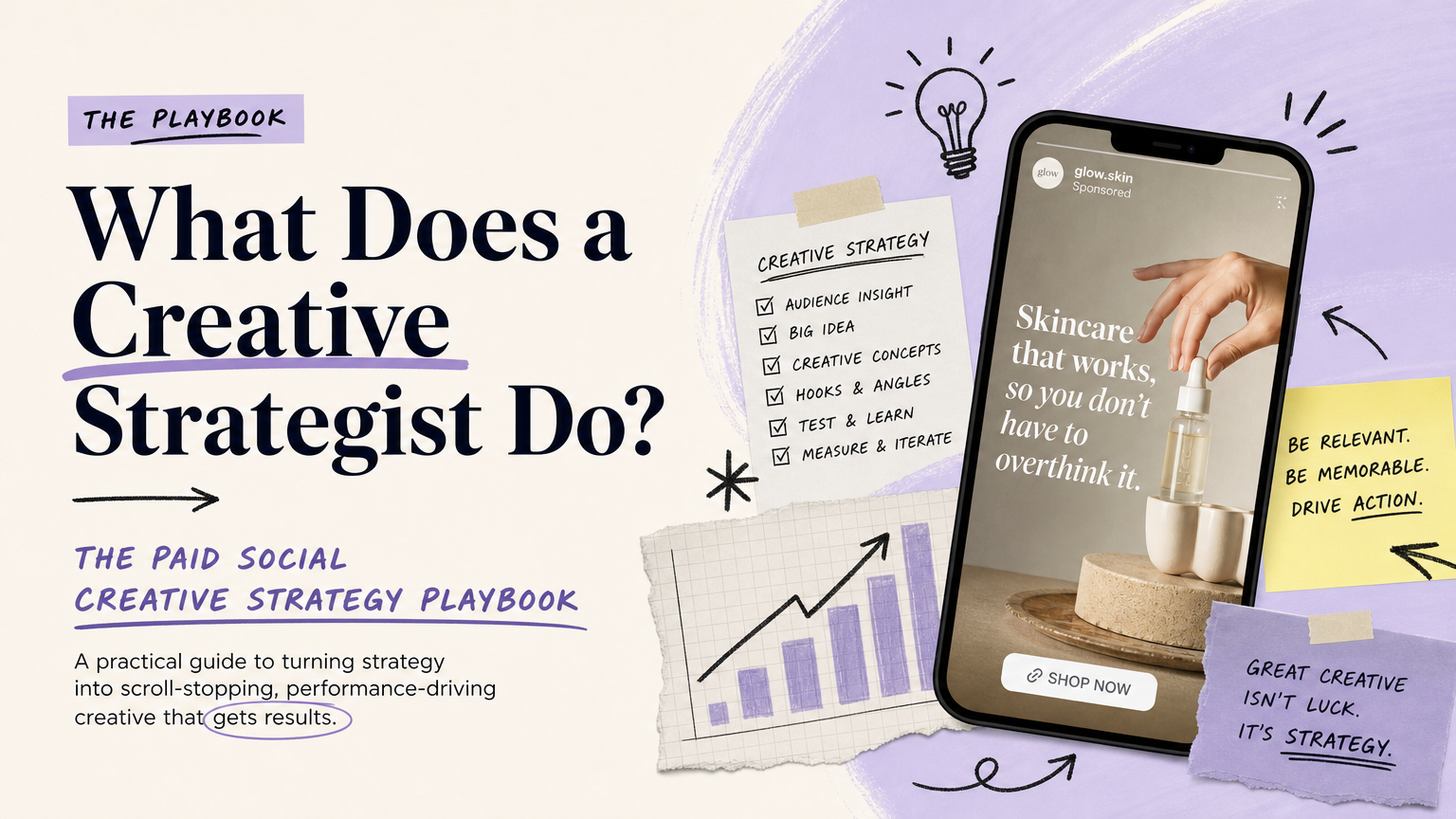
A creative strategist decides what a paid social ad should say, who it should say it to, and why it should work, then designs the test that proves or disproves it. They sit between the people who read the numbers (media buyers, analysts) and the people who make the ads (designers, editors, UGC creators), and their output is the reasoning that connects the two: research, angles, hooks, briefs, test plans and a written record of what the account has learned.
If you search for the title, most of what comes back is job listings. The guides that do rank tend to stop at a list of duties (research, briefs, analysis) without showing what any of that looks like on a Tuesday. This playbook goes further. It defines the role against the four jobs it gets confused with. It then walks through the weekly creative-strategy loop we use (research, hooks, briefs, test, learnings), with the actual artifact each step produces and where an AI agent like Soku does the legwork. It also defines the KPIs precisely from Meta's and TikTok's own help pages, and covers tools, pay data with dates, and how to hire for the role.
Last verified: 2026-10-14. Metric definitions link to the Meta and TikTok help articles we read that day. This page is part of our creative testing cluster: for the statistics of running a test you can actually read (sample sizes, stopping rules, the concept-before-execution hierarchy), the full treatment is our ad creative testing framework. This page stays on the role and the operating loop around it.
What a creative strategist is
In paid social, "creative strategy" means the plan for what the ads say and show. It is not the brand strategy and not the media plan. It answers a narrower set of questions:
- Who is this ad for, and what do they already believe? A first-time buyer comparing options, a lapsed customer, someone who has never heard of the category.
- What problem, desire or objection does it address? One per ad, named in the customer's own words where possible.
- What is the angle? The argument the ad makes: price, speed, a comparison, a before and after, a founder's story, social proof.
- What is the hook? The first one to three seconds of a video, or the headline and image of a static, that earns the rest of the view.
- What proof closes it? A demo, a review, a number, a guarantee.
- How will we know it worked? Which metric, read when, against what.
The creative strategist owns those answers and the evidence about them. The person who holds the camera or the design file may be someone else entirely.
Why the role exists now
Two shifts made this a full-time job. The first is old: creative has always carried most of the weight in advertising results. In a Nielsen analysis of nearly 500 FMCG campaigns from 2016 to the first quarter of 2017, measured by Nielsen Catalina Solutions, creative accounted for 47% of the sales lift from advertising. Reach accounted for 22%, brand factors 15%, targeting 9%, recency 5% and context 2%. The same article notes that in the 2006 Project Apollo work, creative was 65%. Media's combined share had grown to 36% from 15% over those eleven years, but creative was still the largest single lever.
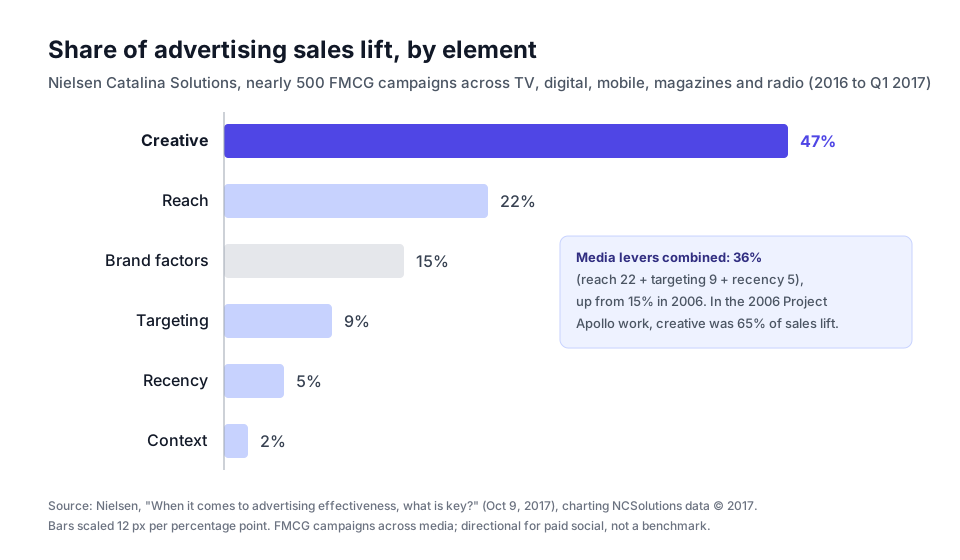
Treat that chart as directional. These are consumer packaged goods campaigns across TV, digital, mobile, magazines and radio, not a paid social benchmark. The direction matters anyway, because the second shift pushes the same way.
The second shift is newer: the platforms took over targeting. Meta's ad retrieval system, Andromeda, is built to pick from a much larger pool of ads for each person. In its December 2024 engineering write-up, Meta said it expects the number of ad creatives to "grow significantly" with generative AI, reporting that over one million advertisers used its generative AI tools to create more than 15 million ads in a single month. When the algorithm decides who sees what, the main input an advertiser still controls is the set of genuinely different ads it hands over. Somebody has to decide what those different ads are. That is the creative strategist.
Creative strategist vs the four roles it gets confused with
| Role | Owns | Main question | Typical output |
|---|---|---|---|
| Creative strategist | What the ads say and why; what the account has learned | Which idea should we make next, and did the last one work? | Research doc, hook bank, briefs, test plan, learnings log |
| Designer / video editor | How the ad looks and moves | Is this well made and on-spec for every placement? | Finished image and video files |
| UGC creator | On-camera delivery | Does this feel like a real person talking? | Raw footage and takes |
| Media buyer | Where the money goes | Should we scale, hold or cut this campaign? | Campaign structure, budgets, bids, pacing |
| Creative director | Quality and consistency of the brand's creative | Is this good, and is it us? | Creative standards, reviews, team direction |
The overlaps are real. On a two-person team the media buyer often does creative strategy on Mondays. In an agency, a "senior creative strategist" may effectively be a creative director for performance work. The useful test is where the person's week goes. If most of it goes into research, briefs and reading results by concept, they are doing creative strategy, whatever the title says. For the buyer's side of this split, see what media buying is.
What the job looks like in real postings
Job descriptions are a better source than glossaries for what employers actually expect. Two recent postings show the range.
Motion, the creative analytics company, listed a remote Creative Strategist role (removed May 13, 2026) whose responsibilities were: conduct customer research (reviews, Reddit, competitor ads, comments, interviews) and turn it into briefs and hypotheses; run creative tests where each test has a specific hypothesis; write briefs and scripts that define what to make and what each test is answering; and own funnels from first brief to post-launch analysis. Its requirements included "a winning ad you can explain, including its hypothesis and results" and active use of AI tools such as Claude or ChatGPT in the current workflow.
A London D2C role posted through the recruiter Salt, titled Creative Strategist (Paid Social), leaned the other way. It asked for ownership of Meta and TikTok campaign strategy, structured testing frameworks and budget scaling against ROAS and CPA targets, plus turning "performance insights into creative direction for content and influencer teams." That is half media buyer, half strategist.
Read together, the common core is research, briefs, hypotheses and test reads. Which side of the line it sits on, closer to production or closer to the ad account, depends on the team. Ask which version a company means before you take, or post, the job.
The weekly creative-strategy loop
Here is the original part of this guide: the loop we run every week, and the artifact each step produces. The artifacts matter more than the calendar. Each one is the input to the next step, so if one is missing, the loop breaks and the team goes back to making ads on instinct.
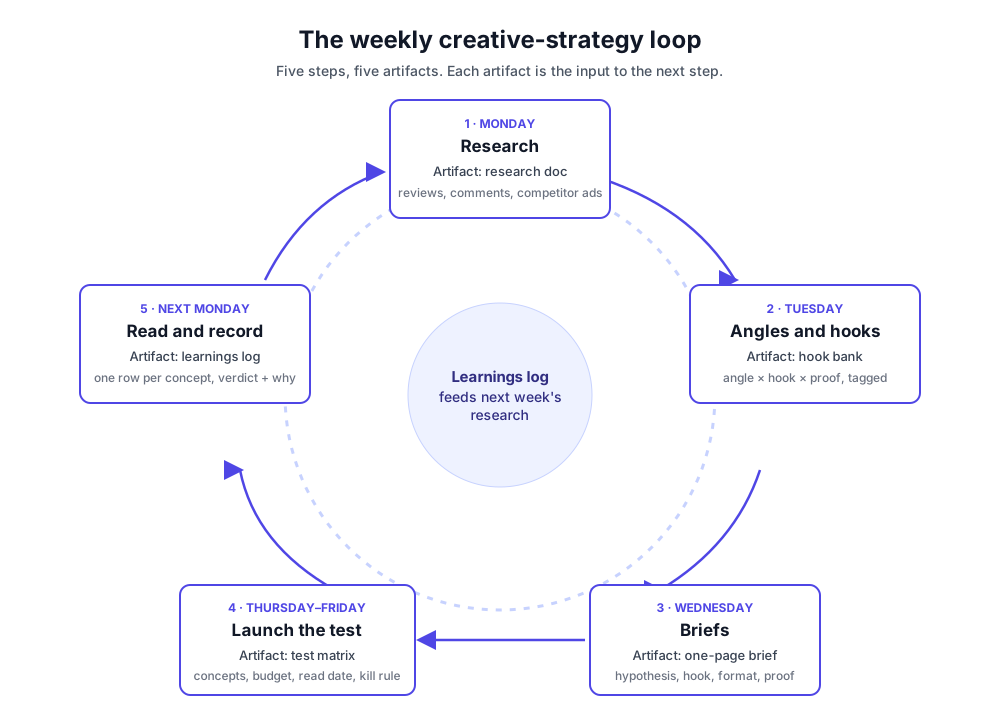
A small account can run the whole loop with one strategist and one editor. A bigger one runs several loops at once, one per product or audience, with the same five artifacts.
Step 1, Monday: research, which produces the research doc
The research doc is a living document, not a one-off deck. Each week it gets new material from four sources:
- Customer language. Product reviews (yours and competitors'), support tickets, post-purchase survey answers, and comments under your own ads and organic posts. You are looking for the exact phrases people use for the problem, the moment it bites, and what they tried before.
- Community threads. Reddit, forums and comments under creators in your category. These surface objections that reviews don't, because people who haven't bought yet are the ones talking.
- Competitor ads. What is running, how long it has been running, and which formats keep coming back. Longevity is a rough signal, not proof, that an ad is working. The free official sources (Meta Ad Library, TikTok Creative Center) cover most of this; our ad spy tools comparison covers the paid ones.
- Your own learnings log. Last week's verdicts decide what this week's research should dig into.
Photo by UX Indonesia on Unsplash.
The research doc has a fixed shape so it can be scanned in five minutes:
| Section | What goes in it | Example entry |
|---|---|---|
| Problems | The pain, in the customer's words, with source and count | "My foundation slides off by noon" (14 reviews, 3 Reddit threads) |
| Desires | The outcome they want, in their words | "Looks like skin, not makeup" |
| Objections | Why people hesitate | "Every 'long-wear' product dries me out" |
| Moments | When the problem shows up | Afternoon meetings, humid commutes |
| Competitor patterns | Angles and formats competitors repeat, with run length | Three brands running side-by-side wear tests for 60+ days |
| Open questions | What we still don't know | Does the dryness objection matter more than price? |
The example entries here and in the tables below follow one illustrative foundation brand through the week. They show the shape of each artifact, not real results.
Where Soku helps. Soku can search competitor ads across Meta, TikTok, YouTube and LinkedIn through its Foreplay integration, including when each ad started running. It can pull public posts and comments from social platforms such as TikTok, YouTube, Instagram and X through TikHub, and it can analyze competitor videos for recurring formats and angles. It drafts the first pass of the research doc from those sources. The strategist still decides which problems are real and which are noise.
Step 2, Tuesday: angles and hooks, which produces the hook bank
An angle is the argument; a hook is the opening that makes someone stay for it. One angle ("our formula doesn't dry you out") can be opened with many hooks: a question, a visual demonstration, a confession, a bold claim, a comparison. Keeping them separate is the most useful discipline in the whole job, because it lets you learn which arguments work independently of which openings work.
The hook bank is a spreadsheet with one row per hook:
| Column | Purpose |
|---|---|
| ID | Stable reference for briefs and the learnings log |
| Angle | The argument this hook opens (links to the research doc row) |
| Hook text or visual | The exact first line, or the first-frame description |
| Hook type | Question, demo, confession, comparison, claim, pattern-break, testimonial |
| Proof it sets up | What the rest of the ad has to deliver |
| Source | Review, comment, competitor ad, or our own past winner |
| Status | Idea, briefed, live, won, lost, retired |
| Result link | Row in the learnings log once tested |
Two rules keep the bank useful. First, every hook should trace back to a line in the research doc. A hook nobody can trace to a customer truth is a guess. Second, mark retired hooks rather than deleting them, so nobody "discovers" the same losing idea three months later.
Hook strength is measured with hook rate, defined in the KPI section below. A dedicated guide to that metric is on our roadmap, so here we only cover how it fits into the loop.
Step 3, Wednesday: briefs, which produce the one-page brief
The brief is the contract between the strategist and whoever makes the ad. A good one fits on one page and leaves the maker free to make choices about craft. A bad one is either a vibe ("make it pop, Gen Z energy") or a shot-by-shot script that leaves nothing to the editor.
Here is the template we use. Each field answers a question the maker or the reader of the results would otherwise have to come back and ask:
CONCEPT ID:        C-2026-41-03
HYPOTHESIS:        People who fear dryness will respond to a wear test
                   that shows skin texture at hour 8, more than to a
                   generic long-wear claim.
AUDIENCE:          Women 25-44 who already wear foundation daily;
                   broad targeting, no interest stack.
PROBLEM (THEIR WORDS): "Every long-wear product dries me out."
ANGLE:             Long wear without the trade-off.
HOOKS (pick 1, film all 3):
  H-118  Close-up of cheek at 8pm, "This is hour eight."
  H-119  "I stopped buying long-wear foundation. Then this."
  H-120  Split screen: two products, same face, 6 hours later.
PROOF:             Real-time wear test footage; 1 review quote on screen.
CTA:               Shop the shade finder.
MUST SAY:          Shade range count (from approved claims sheet).
MUST NOT SAY:      "Never" / "100%" / any skin-condition claims.
FORMAT:            9:16 video, 20-30s, captions burned in, safe zones
                   respected; 4:5 static cut-down from frame at 0:04.
MAKER NOTES:       Natural light. Creator on camera, not voice-over.
HOW WE JUDGE IT:   Hook rate and hold rate after the read threshold
                   in the test matrix; then [CTR](/glossary/ctr); CPA at concept level.
The fields people skip most are HYPOTHESIS and HOW WE JUDGE IT. Without them, the finished ad goes live, performs however it performs, and nobody can say what was learned. With them, even a losing ad answers a question.
For placement specs and the parts of a 9:16 frame that platform UI covers, see our Facebook and Instagram ad sizes and safe zones guide.
Where Soku helps. Soku can draft briefs from the research doc and the hook bank. It can also produce variants directly: its creative tools include image models such as GPT Image 2 and Nano Banana 2 and video models such as Seedance and MiniMax H3, and a video pipeline that goes from product context and competitor research to script, voiceover, music and captions. For a team without an editor, that turns a Wednesday brief into Thursday drafts. For a team with one, it gives the editor rough cuts to react to instead of a blank timeline. For the wider landscape, see creative automation for paid social.
Step 4, Thursday and Friday: launch, which produces the test matrix
The test matrix is the plan for how this week's concepts go live and when they get judged. It is written before launch, not reconstructed after.
| Concept | Hypothesis (short) | Variants | Budget / day | Read metric | Read threshold | Kill rule | Read date |
|---|---|---|---|---|---|---|---|
| C-41-01 | Price-anchored comparison beats claim | 3 hooks × 1 body | Even split | Hook rate, then CPA | Impressions per variant set in advance | Hook rate in bottom third of account after threshold | Next Mon |
| C-41-02 | Founder story builds trust with cold audience | 2 hooks × 1 body | Even split | Hold rate, then CTR | Same | No clicks after threshold | Next Mon |
| C-41-03 | Wear test beats long-wear claim | 3 hooks × 1 body | Even split | Hook rate, hold rate, CPA | Same | Same | Next Mon |
We deliberately leave the statistics out of this page. How many impressions or conversions a read needs, how to structure concept rounds before execution rounds, and why you should not stop a test the first time a number looks good are all covered in the ad creative testing framework. The matrix is where those rules get written down for this specific week, so nobody changes them mid-test.
One practical note about platforms: Meta's delivery system does not split traffic evenly between ads in the same ad set. It shifts delivery toward whatever it predicts will perform. That is good for results and bad for clean reads, which is why the matrix names the read metric and threshold in advance, and why the framework post covers when to use the platforms' own experiment tools.
Where Soku helps. Soku can create campaigns, ad sets and ads on Meta and TikTok, including bulk-creating ads and batch-deploying image and video ads to Meta from a list of creatives. Changes to a live ad account go to a person for approval first, unless the team has granted a standing "Always allow" for that type of action. Some actions can never get a standing grant: changes to Soku's guardrail rules (including its emergency stop) and paid third-party data or generation calls always ask each time. Soku does not run A/B experiments itself. It launches the ads in the structure your matrix specifies, and the platform does the delivery.
Step 5, next Monday: read and record, which produces the learnings log
The learnings log is the most valuable document a creative team owns and the one most teams don't keep. It has one row per concept, not per ad, because the concept is what you will reuse:
| Column | Example |
|---|---|
| Concept ID and angle | C-41-03, long wear without dryness |
| Hypothesis | Wear test beats long-wear claim with dryness-fearing buyers |
| What ran | 3 hooks × 1 body, 9:16 video plus 4:5 static |
| Read | Hook rate top third of the account for 2 of 3 hooks; hold rate middle; CPA at concept level better than the account's trailing 30 days |
| Verdict | Won, iterate |
| Why we think so | The hour-8 close-up hook beat the spoken hook; visual proof outperformed the claim |
| Next action | Brief 3 new bodies on the winning hook; test the dryness angle on TikTok |
| Confidence | Medium: one week, one audience |
Use four verdicts and stick to them: won, iterate (the concept worked, make more executions); lost, retire (the concept failed on the read metric, stop); inconclusive (the read threshold was not reached, rerun or drop); and won, fatigued (it worked and has since decayed). The last one is a different problem with a different fix, covered in our creative fatigue benchmarks. Fatigue depends on frequency against audience size rather than on the calendar.
The "Why we think so" column is where the strategist earns their salary. A number says what happened; the explanation is the hypothesis for next week's research, which closes the loop.
Where Soku helps. Soku's creative audit reads Meta ad-level video metrics and flags fatigue and frequency signals, weak or missing variants, and which segment of a video loses viewers. Its reports cover Google, Meta and TikTok performance with KPI trends. The audit is read-only and never pauses or edits ads. The verdict and the "why" stay with the strategist.
The KPIs a creative strategist uses, defined precisely
Most arguments about whether an ad "hooked" come down to two people using different definitions. Write yours down. These are the underlying platform metrics, quoted from the platforms' help pages:
| Platform metric | Official definition (paraphrased from the source) | Source |
|---|---|---|
| Meta: Video plays | Number of times the video starts to play, counted per impression, excluding replays | Meta video ad metrics |
| Meta: 3-second video plays | Number of times the video plays for at least 3 seconds (or nearly its full length if shorter), counted per impression, excluding replays | Meta video ad metrics |
| Meta: Video plays at 25/50/75/95/100% | Number of times the video was played at that share of its length, including plays that skipped to that point | Meta video ad metrics |
| Meta: ThruPlays | Number of times the video was played to completion or for at least 15 seconds | Meta video ad metrics |
| TikTok: 2-second video views | Number of times the video starts playing for at least 2 seconds in an impression session, excluding replays | TikTok video play metrics |
| TikTok: 6-second video views | Plays of at least 6 seconds in an impression session, full plays of shorter videos, or at least one engagement in the first 6 seconds | TikTok video play metrics |
| TikTok: Video views at 25/50/75/100% | Number of times the video was played at least that share of its length | TikTok video play metrics |
The creative-strategy KPIs are ratios built on top of those. None of them is an official platform column, which is exactly why the definition has to be fixed:
- Hook rate (also called thumb-stop rate). The share of impressions that turned into a view. The most common version is 3-second video plays ÷ impressions on Meta. Soku's built-in version is video plays ÷ impressions, using Meta's video play count, and for TikTok video play starts ÷ impressions. Both are defensible; mixing them in one comparison is not.
- Hold rate. The share of people who stayed after the hook. Definitions vary widely: you will see ThruPlays ÷ 3-second plays, 50% plays ÷ impressions and other combinations. Soku's version is 75% plays ÷ video plays, which deliberately divides by plays rather than impressions so that hold is independent of hook.
- Click-through rate. Clicks ÷ impressions. On Meta, decide whether you mean all clicks or link clicks, since all clicks include likes, profile taps and "see more."
- CPA by concept. Spend ÷ conversions, summed across every ad that belongs to one concept. This is the number that decides whether a concept wins, because individual ads in a concept split delivery unevenly and their individual CPAs are noisy.
- Spend share. What share of the ad set's spend each ad received. A concept that never got delivery hasn't lost; it hasn't been tested.
Two more rules make these numbers usable. Read video metrics at the ad level, because they do not roll up cleanly: an ad set's blended hook rate mixes creatives with different lengths and can be close to meaningless. And read them in a fixed order: hook, then hold, then CTR, then CPA. A concept with a strong hook and a weak hold has a body problem, and one with a weak hook and a strong hold has an opening problem. Each diagnosis points to a different brief.
The upper-funnel metrics are early proxies. They accumulate quickly, so you can read them days before conversions are trustworthy, but they are not the goal. A hook that stops thumbs and sells nothing is a lost concept. If you report these weekly, our Facebook ads reporting template has a layout that keeps creative metrics next to spend.
The tools a creative strategist actually uses
Tool lists in this space are usually written by a vendor recommending itself. Here is the stack by job, without rankings:
| Job in the loop | Tool category | Examples |
|---|---|---|
| Research: competitor ads | Official ad libraries; paid ad spy tools | Meta Ad Library, TikTok Creative Center; see our ad spy tools comparison |
| Research: customer language | Review sites, social listening, community search | Your review platform export, Reddit, comment exports |
| Hooks and briefs | Docs and spreadsheets; AI writing assistants | Notion, Google Docs or Sheets, Claude, ChatGPT |
| Production | Design and video editing; AI image and video generation | Figma, CapCut, Premiere; image and video models |
| Launch | The ad platforms; bulk-launch tools | Meta Ads Manager, TikTok Ads Manager |
| Read | Creative analytics; reporting | Platform reporting, creative analytics tools such as Motion |
| Memory | The learnings log | A spreadsheet is fine; consistency matters more than software |
Notice that the most important tool, the learnings log, is a spreadsheet. Teams that buy a creative analytics platform without a learnings log end up with prettier charts and the same amnesia.
Soku fits across several rows. It does the research collection, the per-ad read and the launch, from one chat, with approvals on account changes. It is not a design tool, and it doesn't replace the platform's own experiment features.
Pay and the job market, with sources and dates
Pay numbers for this role circulate widely without dates or sources, so here is what can actually be cited:
- No government series. The US Bureau of Labor Statistics does not track "creative strategist" as an occupation. The closest management-level category, advertising and promotions managers, had a median annual wage of $133,660 in May 2025, and BLS projects employment of advertising, promotions and marketing managers to grow 6% from 2025 to 2035. That is a more senior role, so treat it as a ceiling reference for heads of creative strategy, not as a strategist salary.
- Job postings. The London D2C role above listed £50,000 to £65,000. Postings are the most honest data because they are real offers, but they vary with city, seniority and how much media buying the role includes.
- Aggregators. Salary sites publish averages for the title, but they disagree with each other by tens of thousands of dollars and some pages haven't been updated in years. Comparably, for example, shows an average of $116,551 on a page last updated November 13, 2023. If you use an aggregator, check its update date and sample size before you anchor a negotiation on it.
The practical takeaway for hiring managers: price the role by its scope. A strategist who also owns budgets and campaign structure is doing two jobs, and the posting should say so.
Certification. Meta offers a Meta Certified Creative Strategy Professional credential. Its listed skills include creative briefs, mobile-first creative briefs, audience-based insights, and creative testing and optimization, and it must be maintained annually. It signals vocabulary rather than ability, but it is a reasonable structured starting point for someone coming from an adjacent role.
How to hire a creative strategist (or get hired as one)
Portfolios of finished ads are a weak signal for this role. The ads were made by editors, approved by clients and launched by buyers. What you need to see is reasoning.
A work sample that takes two to three hours. Give the candidate a real product page, 50 public reviews (yours or a competitor's), and links to three competitor ads currently running. Ask for:
- A one-page research summary: the three problems and two objections they would build around, with the review lines that support each.
- Ten hooks across at least three angles, labeled by angle and hook type.
- One complete brief using your template, including the hypothesis and how it would be judged.
- A short test plan: which concepts first, what they would read, and what result would make them stop.
You are grading traceability (does every hook connect to evidence?), separation (are angles and hooks distinct?), and honesty about uncertainty (do they say what a test could not prove?).
Interview questions that separate strategists from producers:
- "Walk me through a winning ad you worked on. What was the hypothesis, and how do you know it was the concept and not the targeting or the timing?"
- "Tell me about a concept you were sure would win that lost. What did you change in your research afterwards?"
- "Hook rate is high and CPA is bad. What are three explanations, and what would you brief next for each?"
- "How do you decide when a concept is fatigued versus never having worked?"
- "What do you need from the media buyer to do your job, and what do they need from you?"
Red flags: talking only about aesthetics, never mentioning the customer's words, judging ads on single-ad CPA after a day, and no system for remembering past results.
If you're trying to get in. Most strategists come from copywriting, video editing, UGC creation, social media management or media buying. Build the work sample above for a brand you admire, using only public data, and publish it. That one document shows more than a reel of finished ads.
Where AI fits, and what stays human
The slow half of this job is mechanical: collecting ads and comments, tagging creatives by hook and format, computing per-ad ratios, drafting variations, resizing for placements. That half is moving to software quickly, and it should. A strategist who spends Monday copying review text into a doc is not doing strategy.
The judgment half does not move as easily:
- Choosing which customer truth deserves a concept. Models summarize what's common; the winning angle is often a minority complaint stated unusually well.
- Knowing what the brand will and won't say. Claims compliance, tone and the founder's red lines live in people's heads before they live in a document.
- Interpreting a result. "Hook rate up, CPA flat" has several explanations, and choosing the right one depends on knowing what else changed in the account that week.
- Owning the learnings log. The log is only as good as the honesty of its "why" column.
Our working model with Soku is the split in the loop diagram. Soku assembles the research doc inputs, drafts hooks and briefs for the strategist to edit, produces image and video variants, launches what the strategist approves, and reads ad-level hook rate, hold rate and fatigue back into a report. The strategist chooses the bets and writes the verdicts.
Common mistakes that break the loop
- Testing executions before concepts. Changing button colors on an angle nobody wants. Test the argument first; polish winners later.
- One variable per ad, many variables per week. Teams carefully isolate hooks within a concept, then change the audience, budget and landing page in the same week. Hold the rest still while a concept is being read.
- Judging individual ads instead of concepts. Platform delivery is uneven by design, so roll up to the concept before calling it.
- No read date. Without a date written in the matrix, tests end when someone gets nervous.
- Briefs without hypotheses. The ad runs, nobody learns anything, and the next brief starts from zero.
- Treating competitor longevity as proof. A competitor's ad running for 90 days suggests it's working for them, with their offer and their audience. It is a lead for your research doc, not a template to copy.
- Losing the log. A strategist leaves and the account's memory leaves with them. Keep the learnings log in a shared place from day one.
Frequently Asked Questions
What does a creative strategist do?
A creative strategist decides what an ad should say, who it is for and why it should work, before anyone designs or films it. On a paid social team that means researching customers and competitors, turning the findings into angles and hooks, writing briefs for designers, editors and creators, planning the test that will judge each concept, and reading the results back into the next round. The output is not the ad itself but the reasoning behind it and the evidence about whether that reasoning held up.
What is the difference between a creative strategist and a media buyer?
The media buyer owns where the money goes: campaign structure, budgets, bids, audiences, pacing and the account's overall cost per result. The creative strategist owns what the money is spent showing: the concepts, hooks and formats, and the read of which ones worked and why. They share the same performance data but ask different questions of it. A buyer asks whether to scale or cut a campaign; a strategist asks why one concept beat another and what to make next.
Is a creative strategist the same as a creative director?
No. A creative director owns the quality and consistency of the brand's creative output and usually manages the designers, writers and editors who make it. A creative strategist owns the direct-response logic: which customer problem an ad addresses, which hook opens it, which proof closes it, and whether the data says it worked. In small teams one person can hold both, but the creative director's question is whether the work is good and on-brand, while the strategist's question is whether it moved the number and what we learned.
What KPIs does a creative strategist use?
The usual read, in order, is hook rate (how many impressions turned into video plays or 3-second plays), hold rate (how many of those plays reached a later point such as 75% of the video), click-through rate, and cost per acquisition grouped by concept rather than by individual ad. These are derived from platform metrics that Meta and TikTok define in their help centers, so the most important rule is to write down which definition your team uses and compare only like with like.
How much does a creative strategist make?
There is no government wage series for creative strategists, so any number comes from job postings or salary aggregators, which disagree. As one dated reference point, a London D2C paid social creative strategist role posted through the recruiter Salt listed £50,000 to £65,000. The closest US government benchmark is the Bureau of Labor Statistics figure for advertising and promotions managers, a more senior management role, whose median annual wage was $133,660 in May 2025.
What should a creative brief for a paid social ad include?
At minimum: the hypothesis the ad is testing, the audience and the specific problem or desire it addresses, the angle, two or three written hooks, the format and length, the proof the ad will show, the call to action, the mandatory and forbidden claims, the placements and aspect ratios, and how the result will be judged. A brief that names the hypothesis and the read metric is what turns a finished ad into a test the team can learn from.
Can AI replace a creative strategist?
Not the judgment part. AI tools now handle a lot of the slow work around the role: collecting competitor ads and customer comments, tagging ads by hook and format, computing hook and hold rates per ad, drafting hook variations and producing image and video variants. Deciding which customer truth is worth building a concept around, what the brand will and will not say, and what a test result actually means still needs a person who understands the product and the customer.
How do I become a creative strategist?
Most people arrive from an adjacent role: copywriting, video editing, UGC creation, social media management or media buying. The fastest way in is a portfolio that shows reasoning rather than polish: pick a real brand, mine its public reviews and comments, write a hook bank and two briefs, and explain which concepts you would test first and how you would judge them. Meta also offers a Meta Certified Creative Strategy Professional credential covering mobile creative strategy and creative briefs.
Related reading
- Ad creative testing framework: sample sizes, stopping rules and the concept-before-execution hierarchy behind the test matrix.
- Creative fatigue benchmarks: how to tell a fatigued winner from a concept that never worked.
- Best ad spy tools: the free and paid sources for the competitor section of the research doc.
- Creative automation for paid social: what to automate first once the loop is running.
- What is media buying?: the other half of the strategist and buyer partnership.