 Soku AI
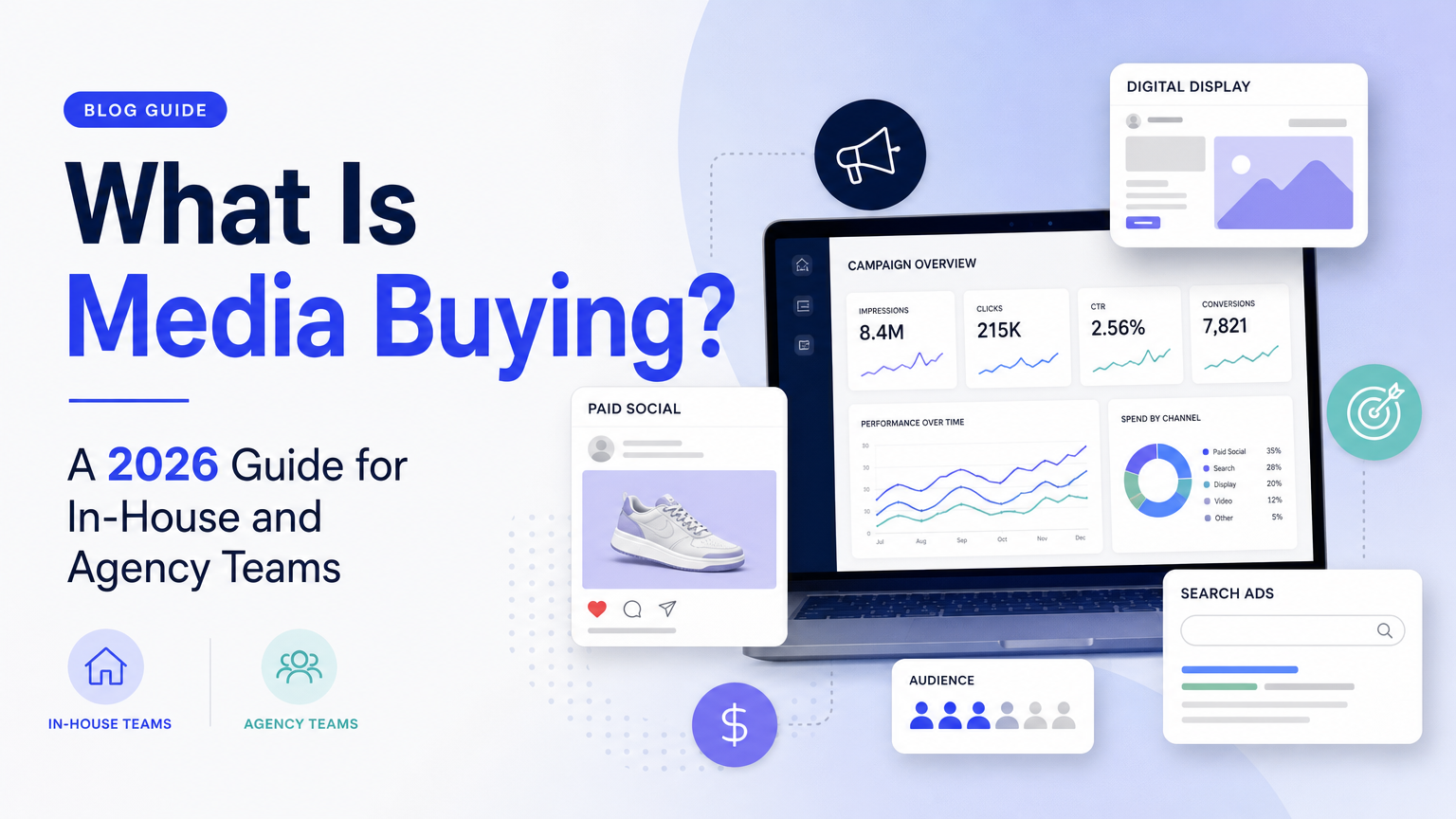
Media buying is the work of purchasing ad placements and running them so a budget produces a business result. The media buyer decides where an ad shows, how much to pay for it, when to move money, and when to stop. In 2026 most digital media is bought through auctions rather than negotiated by phone, so the job has shifted from haggling over rates to setting bids, budgets, targeting and creative, then reading the results and acting on them.
This guide is for marketers inheriting a paid media budget, founders choosing between an in-house hire and an agency, and new buyers who want the mechanics explained from the platforms' own documentation. It covers media buying vs media planning, the four ways to buy an impression, how Google's and Meta's auctions price ads, pricing models, in-house vs agency, KPIs and a worked budget example.
It ends with something the pages ranking for this question don't have: a Monday-to-Friday media-buying week, task by task, with a column marking which tasks an AI agent like Soku handles today and which stay with a person.
Last verified: 2026-10-13. Platform mechanics link to the Google, Meta and TikTok help articles we read that day. The one market statistic comes from the IAB and PwC. Worked examples are illustrative arithmetic with stated assumptions, not benchmarks. If you're specifically evaluating AI for this job, the dedicated pages are the AI media buyer guide, the ranked AI media buying tools and AI vs human media buyer. This page stays on the fundamentals.
Media buying, defined
Media buying is the purchase and management of advertising inventory: the space or time where an ad can appear. Inventory is anything an audience looks at that a seller is willing to put an ad in front of:
- Search: Google, Bing, and AI answer surfaces such as ChatGPT.
- Social: Meta, TikTok, LinkedIn, Snapchat, Pinterest, Reddit and X.
- Display, video and CTV: websites, apps, YouTube and streaming TV, much of it sold through ad exchanges.
- Commerce media: retailer sites and apps (see our retail media networks explainer).
- Offline: linear TV, radio, print and out-of-home, still mostly bought directly.
The buyer's job has three parts. Acquire the inventory at a price that makes sense, either by winning auctions or by negotiating a deal. Operate the campaigns once they run: pacing, bids, targeting, creative rotation, exclusions, tracking. Account for the money: report what it produced, reconcile what was billed, and explain the result to whoever owns the budget.
The scale is large. The IAB and PwC Internet Advertising Revenue Report, released April 16, 2026, puts US internet advertising revenue at $294.6 billion in 2025, up 13.9% year over year. Of that, $162.4 billion was programmatic, up 20.5%. That's about 55% of the total by our arithmetic (162.4 ÷ 294.6). The chart below shows how those dollars split by format.
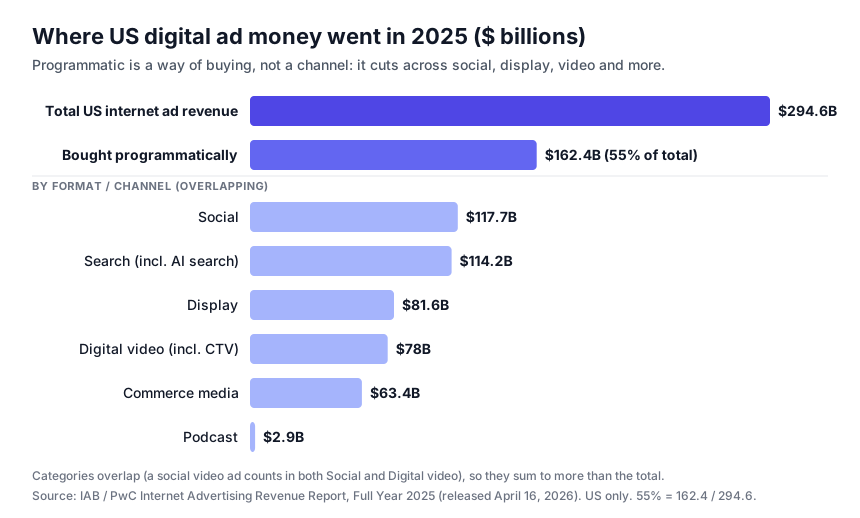
Two things to notice. First, programmatic is a buying method, not a channel. It shows up inside social, display, video and commerce media, which is why the categories overlap and add up to more than the total. Second, social and search together account for most of the money, and both are sold almost entirely through self-serve auctions. If you buy media for a small or mid-sized business, most of your budget probably goes through Google Ads, Meta Ads Manager and TikTok Ads Manager auctions. You won't sign an insertion order at all.
Media buying vs media planning
The two terms get blurred together, especially on small teams where one person does both. They are different jobs with different outputs.
| Media planning | Media buying | |
|---|---|---|
| Core question | Where should the money go, and why? | How do we get those placements at the right price, and keep them working? |
| Output | A media plan: audiences, channels, budget split, flight dates, targets | Live campaigns, bids, budgets, deals, reports |
| Time horizon | Quarter or campaign flight | Daily and weekly |
| Inputs | Business goal, audience research, past results, benchmarks | The plan, platform data, auction dynamics, creative supply |
| Typical decisions | 40% Meta, 35% Search, 25% TikTok test. Target CPA $50 | Move $2,000 from a fatigued ad set to a scaling one. Add negatives. Pause the creative that's burning |
| Measured on | Whether the plan's assumptions hold | Whether delivery hits the plan's targets |
Planning comes first and buying keeps it honest. A good buyer feeds results back into the plan. If the assumed CPA is wrong by 40% after two weeks, the plan needs to change, not just the bids. Our media plan template builds the plan side from your own assumptions and adds a reconciliation block, so you can see where the plan and the buy diverge. For a budget-level view, see the paid media budget planning spreadsheet.
The four ways to buy an impression
Most "what is media buying" pages list "direct, programmatic and self-serve" as three equal options. That mixes up two separate questions. Google Ad Manager, the ad server most publishers use, classifies every transaction on two axes:
- Programmatic vs traditional. Google defines traditional transactions as terms "negotiated and finalized outside of Ad Manager, say via email, spreadsheets, or PDFs", with billing, payments and reconciliation handled manually. Programmatic transactions are negotiated and executed in software.
- Guaranteed vs non-guaranteed. In Google's words, "Non-guaranteed campaigns are not contractually obligated to deliver. Guaranteed campaigns are contractually obligated to deliver based on terms negotiated with a buyer."
Put those together and you get four boxes:
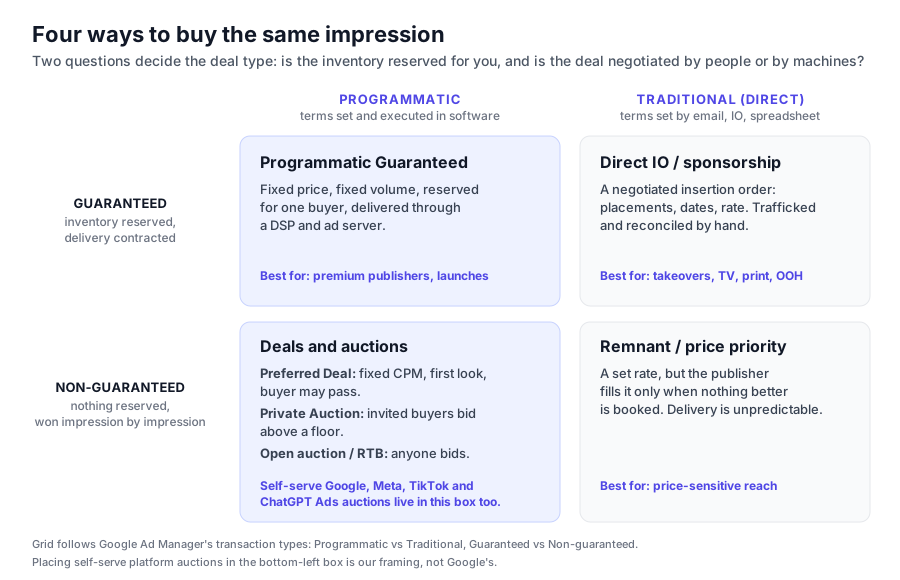
Programmatic Guaranteed
A fixed price and a fixed volume of reserved inventory, bought through software. Google's Programmatic Guaranteed vs Preferred Deals article puts it plainly: "You and the buyer negotiate a price and terms for inventory that's reserved (guaranteed) for that buyer. Inventory is designated only for that buyer at that price." You get the certainty of a direct buy with programmatic delivery, frequency control and reporting. It suits launches, premium publishers and anyone who needs to know the impressions will be there.
Deals and auctions (non-guaranteed programmatic)
This is the biggest box, and it has several tiers. Google's Private Marketplace article describes two negotiated-but-not-reserved deal types:
- Preferred Deal: a fixed CPM, negotiated by proposal. The buyer gets "an initial, or 'preferred,' opportunity to bid at the negotiated price", but the inventory isn't reserved and the buyer isn't required to buy.
- Private Auction: an invitation-only auction with a floor price. Invited buyers compete and the highest qualifying bid wins.
Below those sits the open auction, also called real-time bidding or RTB, where any eligible buyer bids impression by impression through a demand-side platform (DSP). See our DSP and real-time bidding glossary entries.
The self-serve platforms belong in this box too. That's our framing, not Google's: Ad Manager is a publisher tool and doesn't classify Google Ads or Meta. But when you set a bid in Google Ads, Meta Ads Manager, TikTok Ads Manager or ChatGPT Ads, nothing is reserved for you. You win or lose impression by impression in an automated auction.
Direct insertion orders and sponsorships (traditional guaranteed)
The original form of media buying. A buyer and a publisher negotiate placements, dates and a rate, sign an insertion order (IO), and the publisher traffics the ads. This is still how most TV, radio, print, out-of-home, homepage takeovers and sponsorships are sold. It's slow and manual, but it's the only way to buy some inventory.
Remnant and price priority (traditional non-guaranteed)
Inventory sold at a set rate but filled only when nothing better is booked. Ad Manager calls these price priority, network and bulk line items. It costs less than guaranteed inventory, and delivery is unpredictable in exchange.
Which box should you buy in? For performance goals (leads, purchases, installs), most budgets belong in the bottom-left box: self-serve auctions you can start, stop and measure daily. Guaranteed and direct buys make sense when you need a specific audience at a specific moment, like a launch, or when reach certainty matters more than marginal cost.
How the auctions actually work
Because so much media is now bought in auctions, a buyer who doesn't understand auction pricing is guessing. The most common misconception is that the highest bid wins. On the major platforms it doesn't.
Google Ads: Ad Rank, not bid
Google's help center lists six factors that decide whether and where your ad shows: your bid, ad and landing page quality, the expected impact of assets and formats, Ad Rank thresholds, the context of the search, and auction competitiveness. Together they make up Ad Rank.
What you pay is a separate question. Google's actual CPC definition says: "with the Google Ads auction, you only pay what's minimally required to clear the Ad Rank thresholds and beat the Ad Rank of the competitor immediately below you." If nobody is below you, you pay the reserve price.
Google gives a simplified worked example on that page. Five advertisers have Ad Ranks of 80, 50, 30, 10 and 5. The minimum Ad Rank to show above the search results is 40, and the minimum to show below them is 8:
| Advertiser Ad Rank | Shows? | Pays just enough to beat |
|---|---|---|
| 80 | Top, above results | Ad Rank 50 (the next advertiser) |
| 50 | Second, above results | The threshold of 40 (no one else above it) |
| 30 | First below results | Ad Rank 10 |
| 10 | Second below results | The threshold of 8 |
| 5 | Doesn't show | — |
Two practical consequences for a buyer:
- Quality lowers your price. A better ad and landing page raise your Ad Rank at the same bid. So you can hold a position while paying less, or win a position you couldn't afford. That's why a Quality Score audit is media-buying work, not just copywriting.
- Your max bid isn't your price, usually. Google notes your actual CPC is "often less" than your max CPC. It can exceed it when automated bidding or bid adjustments are on.
Google also lets a campaign overspend its daily budget on busy days. Per its overdelivery article, "On a given day, your campaign might spend up to twice your average daily budget," but "At the end of the month, you will have spent no more than 30.4 times your average daily budget." Pacing checks need to account for that. A day at 180% of budget isn't a bug.
Meta: total value, not bid
Meta's About Ad Auctions page says the auction winner "is the ad with the highest total value, subject to a price floor", and that total value combines three factors:
- Bid: what the advertiser is willing to pay to achieve the outcome.
- Estimated action rates: the probability that showing this ad to this person leads to the advertiser's desired outcome.
- Ad quality: a measure built from people's feedback (including hiding the ad) and from assessments of low-quality attributes such as withholding information, sensationalized language and engagement bait.
Meta adds that because estimated action rates and ad quality are part of the auction, "an ad that's more relevant to a person could win an auction against ads with higher bids". It also says its auction adjustments "will not cause us to charge you more than your bid to show your ad."
On billing, Meta's How Meta charges for ads page says "Usually, you're charged based on the number of impressions your ad receives unless specified otherwise during ad creation." That means most Meta campaigns optimized for purchases are still billed per impression. The optimization goal and the billing event are different settings.
The takeaway for a buyer: on auction platforms, targeting, creative and landing page move your price as much as bid and budget do. Our Google Ads auction insights guide covers how to read who you're competing against.
Pricing models: CPM, CPC, CPA, CPV and the rest
Pricing models are where most beginner confusion comes from, because the same three letters can mean a billing event (what you're charged for), a bidding method (what you tell the auction) or a reporting metric (what you divide by afterward).
| Model | What it means | Typically a billing event? | Where you'll see it |
|---|---|---|---|
| CPM | Cost per 1,000 impressions | Yes: default billing on Meta, and on TikTok CPM and oCPM | Social, display, video, CTV, direct deals |
| oCPM | Billed per 1,000 impressions, but delivery is optimized toward an action | Yes, per impression | TikTok's default for conversion and app install objectives |
| CPC | Cost per click | Yes | Google Search, many social platforms optionally |
| CPV | Cost per view | Yes, when the view definition is met | YouTube, TikTok |
| CPA / tCPA | Cost per acquisition or action | Usually a bidding target, not a charge | Google, Meta, TikTok automated bidding |
| ROAS / tROAS | Revenue ÷ ad spend | A bidding target and a KPI, never a charge | Google, Meta value-based bidding |
| Flat fee / CPD | Fixed price for a placement or a day | Yes, contract-based | Sponsorships, takeovers, direct IOs |
Some definitions straight from the platforms:
- TikTok lists four bidding methods: CPM and oCPM are charged by impression, CPC by click, and CPV when someone views the ad for at least 6 seconds or interacts within the first 6 seconds, whichever comes first. TikTok notes oCPM "is the default method for the conversions and app install advertising objectives."
- YouTube CPV bidding charges for TrueView views. For in-stream ads, a view counts when someone watches 30 seconds of the ad, or the whole ad if it's shorter, or interacts with it, whichever comes first. For in-feed ads, a view counts on a thumbnail click or at least 10 seconds of autoplay.
- Google's Target CPA sets "your desired average cost per conversion", and Google sets bids based on how likely each auction is to convert. It's a target the system steers toward, not a price per conversion. Google notes that since June 2026 the strategy is labeled simply "Target CPA" (formerly "Maximize conversions with a Target CPA"). The behavior is unchanged.
The practical rule: know your billing event, but manage to your CPA or ROAS. CPM and CPC tell you what the auction charged. CPA and ROAS tell you whether it was worth it. For quick conversions between them, use the CPM calculator, the CPC calculator and the ROAS calculator. For what these numbers typically look like by platform, see our paid media benchmarks by industry and the per-platform cost guides for Google Ads, Facebook ads and TikTok ads.
A worked budget example
Here is how a buyer turns a monthly budget into expected outcomes, and where the auction mechanics above change the arithmetic. Every input below is an illustrative assumption, not a benchmark. Replace them with your own account's numbers.
Scenario: a DTC brand with a $30,000 monthly budget split across three platforms.
| Meta (prospecting) | Google Search | TikTok (test) | Total | |
|---|---|---|---|---|
| Budget | $15,000 | $12,000 | $3,000 | $30,000 |
| Assumed price | $12.00 CPM | $2.50 CPC | $6.00 CPM | |
| Impressions | 15,000 ÷ 12 × 1,000 = 1,250,000 | n/a (bought per click) | 3,000 ÷ 6 × 1,000 = 500,000 | |
| Assumed CTR | 1.0% | n/a | 0.8% | |
| Clicks | 12,500 | 12,000 ÷ 2.50 = 4,800 | 4,000 | 21,300 |
| Assumed conversion rate | 2.5% | 5.0% | 1.5% | |
| Conversions | 312.5 | 240 | 60 | 612.5 |
| CPA | $48.00 | $50.00 | $50.00 | $48.98 blended |
Three things a buyer would do with this:
Set the Google daily budget correctly. Google budgets are daily averages, and the monthly cap is 30.4 times that average. To spend $12,000 in a month, set an average daily budget of $12,000 ÷ 30.4 = $394.74. Expect single days up to about $789 (2×), because Google allows that. A buyer who sees a $700 day and panics is misreading the platform.
Check the learning budget, not just the CPA. At a $50 CPA, the TikTok test's $3,000 buys about 60 conversions a month, or about 14 a week. TikTok's budget best practices list a minimum budget of 10× your current CPA for deep conversions such as purchases, and advise daily rather than lifetime ad group budgets. Read as a daily figure, that's $500 a day at a $50 CPA, far more than this test's roughly $100 a day. So this test is underfunded to optimize for purchases. A buyer would either raise the budget, optimize for a shallower event, or accept slower learning. Our TikTok ads cost guide has the full per-campaign-type table.
Plan for the CPA to move. The blended $48.98 is a forecast, not a promise. If Meta CPMs rise 20% (to $14.40) with nothing else changing, Meta produces 260.4 conversions instead of 312.5 and its CPA rises to $57.60. The buyer's weekly job is to notice that early and decide whether to fix it with creative, targeting or budget, or to accept it. The ad budget calculator runs this arithmetic on your own inputs.
In-house vs agency media buying
Who does the buying is often a bigger decision than how. There's no universal answer, but the trade-offs are consistent.
| In-house buyer or team | Agency | |
|---|---|---|
| Product and margin knowledge | Deep. Sits next to the product, finance and creative | Learned from briefs and calls |
| Speed of action | Same-day. No ticket or approval chain | Depends on the account team's bandwidth and SLAs |
| Breadth across channels | Limited by headcount and experience | Specialists per channel, cross-client pattern knowledge |
| Direct and offline media | Hard without relationships and volume | Agency relationships and pooled volume can help on direct buys |
| Continuity | One-person risk: vacations, departures | The team covers absences |
| Cost structure | Salary and tools, fixed | Retainer or % of spend, plus account fees |
| Data ownership | Yours by default | Make sure accounts are in your name, not the agency's |
A pattern that works for many teams: keep the accounts, the measurement and the strategy in-house, and buy specialist help where you need it, whether that's an agency for CTV or direct media, or an AI agent for the daily operating work. Either way, make sure the ad accounts and pixels are owned by your business, or switching later means rebuilding your learning history.
For the fully loaded cost math of agency vs in-house vs an AI agent at $30K and $100K in monthly spend, see AI media buyer cost vs an agency.
The KPIs a media buyer is measured on
Buyers track many metrics. They should be judged on a few.
| KPI | What it tells you | Watch out for |
|---|---|---|
| CPA | Cost per acquisition: spend ÷ conversions | Platform-reported conversions double-count across channels |
| ROAS | Revenue ÷ ad spend for a campaign or platform | Ignores margin. A 3× ROAS can lose money on a low-margin product |
| MER | Total revenue ÷ total marketing spend | Blunt but honest. See MER vs ROAS |
| CPM | Price of attention | A low CPM with poor conversion rate is expensive |
| CTR | How compelling the ad is to the people who see it | Rising frequency with falling CTR signals fatigue |
| Conversion rate | How well the click becomes a customer | Usually a landing page or offer problem, not a media problem |
| Frequency and reach | How many people, how often | See reach vs impressions vs frequency |
| Pacing | Spend to date vs plan for the flight | Under-spend is a failure too: the plan's reach never happened |
The most useful habit is one north-star efficiency metric agreed with whoever owns the budget (usually blended CPA, MER or contribution margin) with platform metrics treated as diagnostics. Platform-reported conversions overlap, so adding up what Meta, Google and TikTok each claim usually gives more conversions than you had orders. Our cross-channel attribution guide covers the options.
What a media buyer actually does: a Monday-to-Friday week
Below is a representative week for an in-house buyer running Google, Meta and TikTok for a single brand. It's a composite of the standard paid-media cadence, not one specific account. The last column says who can do each task today. We grounded every "Soku" entry in what the product actually does, described in the next section. Anything it doesn't do is marked human.
| Day | Task | Why it matters | Who does it today |
|---|---|---|---|
| Mon | Pull last week's spend, conversions and CPA across every ad account | The baseline for every decision this week | Soku. Reads synced metrics across connected accounts and writes the report |
| Mon | Pacing check: spend to date vs the month's plan, per campaign | Under- and over-spend both break the plan | Soku drafts, human decides. Any budget increase Soku proposes must cite spend so far, daily budget and the remaining window |
| Mon | Reconcile platform-reported conversions against the backend (Shopify, CRM, GA4) | Platforms over-claim. The business runs on real orders | Shared. Soku can pull GA4 and Shopify data alongside ad data. Choosing the source of truth is a human call |
| Tue | Search terms review and negative keywords | Irrelevant queries quietly burn search budget | Soku proposes, human approves. Classifies search terms against the business and drafts negatives |
| Tue | Creative fatigue review: CTR, CPA and frequency by ad | Fatigue is the most common cause of a rising CPA | Soku. A built-in weekly creative review flags fatigued and winning ads. Pauses go through approval |
| Tue | Brief the next round of creative | Creative supply is the biggest lever in auction buying | Human owns the concept. Soku can generate image and video variants from it |
| Wed | Build and launch new campaigns, ad sets and ads, with correct tracking | Launch errors cost days of learning | Soku drafts, human approves. Create actions on Google, Meta, TikTok, LinkedIn and ChatGPT Ads are all review-gated |
| Wed | Negotiate a direct buy, sponsorship or Programmatic Guaranteed deal | Some inventory isn't in any auction | Human. Soku doesn't negotiate deals or sign IOs |
| Thu | Reallocate budget between campaigns and channels | Moving money to what works is the core of the job | Soku proposes, human approves. Teams can grant a standing "Always" approval per action type and platform |
| Thu | Set or change guardrails (max daily budget, bid caps), or hit the emergency stop | Limits on what any automation is allowed to do | Human sets them in chat. Every guardrail change is itself review-gated |
| Thu | Handle ad disapprovals, policy appeals and account issues | A disapproved ad stops delivery | Human. Soku can read diagnostics but doesn't file appeals |
| Fri | Weekly report for leadership or the client | The budget owner needs a decision-ready summary | Soku drafts, human owns the narrative and the meeting |
| Fri | Billing and invoice reconciliation | What was billed should match what was delivered | Human, with one narrow exception: for ChatGPT Ads accounts that Soku manages, a balance monitor pauses campaigns when funds run low and sends a monthly statement |
| Fri | Decide next week's tests and update the plan | Turns results into strategy | Human |
Read down the last column and a pattern shows. Reading, reporting, flagging and drafting can be handed to an agent today. Committing money, negotiating, choosing the measurement truth and answering for the result can't. Even where Soku can act, the default is that it proposes and a person approves.

Photo: John (@johnishappysometimes) on Unsplash.
That's a different split from the usual "AI handles bids, humans handle strategy." The reporting rows are where an agent saves the most time with the least risk, because nothing it does there touches a live account.
How Soku fits in, and where it stops
We built Soku as an AI agent for paid media, so here is exactly what it does in the week above. Each item is a capability in the product, not a roadmap item.
- Cross-platform reading. Soku connects to Google Ads, Meta, TikTok, LinkedIn and ChatGPT Ads accounts, and syncs campaign metrics for each into one place. So "pull last week's numbers across every account" is one question instead of four exports.
- Scheduled reports. Two built-in Autopilot routines cover the Monday and Tuesday rows. A Daily Performance Report pulls yesterday's and the trailing seven days' spend, CPA and conversions for every linked ad account, checks them against your goals, and writes a report. A Weekly Creative Review pulls ad-level CTR, CPA and frequency for the trailing seven days, then flags fatigued and winning creatives. Both are off until you turn them on. Both are told to submit a proposal only for clearly safe changes and to put everything else in the report.
- Approval-gated changes. Every action that changes a live ad account requires review: creating or editing campaigns, ad groups, ads, budgets, bids, keywords, negatives, audiences and targeting. Soku drafts the change and a person approves it. Budget increase proposals must cite pacing, and if recent days spent well under budget, Soku is instructed to say budget isn't the constraint rather than propose more.
- Standing approvals and guardrails. If you trust a class of change, you can grant an "Always" approval for that action on that platform. Guardrails such as spend limits and bid caps are set in chat, and changing a guardrail is itself review-gated, so the agent can't quietly loosen its own limits. An emergency stop pauses delivery.
- What it doesn't do. Soku doesn't negotiate direct deals, sign insertion orders, buy Programmatic Guaranteed inventory, file policy appeals or decide your measurement source of truth. Those rows stay with you.
For the AI-specific operating model, read the AI media buyer guide. To compare tools, see the best AI media buying tools, ranked. For setup, see how to automate media buying with AI. For head-to-heads, see Meta Business Agent vs a human media buyer and AI media buyer vs human media buyer.
Common media-buying mistakes
The patterns that most often waste a budget, in rough order of cost:
- Managing to the billing metric. Celebrating a cheap CPM or CPC while CPA climbs. The auction is happy to sell you cheap impressions to people who won't buy.
- Underfunding the optimization event. Asking an algorithm to find purchases with a budget that buys three a week. It can't learn, so performance looks random. Optimize for a shallower event or consolidate budgets.
- Editing during learning. Big changes to budget, bids, targeting or creative reset the learning on most platforms. Batch your changes and give them time.
- Reading pacing wrong. Treating Google's normal 2× daily overdelivery as a fault, or missing a week of under-spend.
- Trusting summed platform conversions. Adding up every platform's claimed conversions and reporting the total. Agree on one source of truth.
- Letting creative run dry. In auction buying, creative quality moves price. A buyer with no fresh creative is left with bids and budgets, the weakest levers. See our creative fatigue benchmarks.
The bottom line
Media buying in 2026 is less about who you know and more about how well you run the loop: plan, buy, read, adjust, report. The platforms automate more of the bidding every year. The work that's left is choosing the goal, feeding the auction good creative, reading the results honestly and deciding where the next dollar goes. That's still a person's job, and it's the part worth getting good at.
Frequently Asked Questions
What is media buying in simple terms?
Media buying is the job of purchasing ad placements (on search engines, social feeds, websites, apps, streaming TV, radio, print or billboards) and then running them so the budget produces the result the business wants. In digital advertising most of that buying now happens through auctions, so a media buyer spends less time negotiating rates and more time setting bids, budgets, targeting and creative, then reading the results and moving money toward what works.
What is the difference between media buying and media planning?
Media planning decides where the money should go: the audience, the channels, the budget split, the flight dates and the targets. Media buying executes that plan: it purchases or bids for the inventory, launches the campaigns, watches pacing and performance, and reallocates budget inside the plan. On small teams one person does both. On large teams and at agencies they are often separate roles, and the plan is the document the buyer is held to.
What does a media buyer do day to day?
A typical week includes pulling and reconciling performance across ad accounts, checking budget pacing against the flight, reviewing search terms and creative fatigue, launching new campaigns or ad sets with correct tracking, reallocating budget between campaigns and channels, handling ad disapprovals, negotiating any direct or programmatic guaranteed deals, and reporting results to stakeholders or clients. Much of the reading, reporting and drafting can now be done by an AI agent, while the decisions about money, strategy and accountability stay with the buyer.
How do ad auctions decide what I pay?
Not by bid alone. Google ranks ads by Ad Rank, which combines your bid, ad and landing page quality, Ad Rank thresholds, the context of the search, the expected impact of assets and the competitiveness of the auction. Google says your actual cost per click is what you minimally need to clear the thresholds and beat the Ad Rank of the advertiser immediately below you, so it is often less than your maximum bid. Meta picks the ad with the highest total value, which combines your bid, estimated action rates and ad quality, and says auction adjustments will not charge you more than your bid.
What is the difference between CPM, CPC, CPA and CPV?
They are pricing units. CPM is cost per thousand impressions, CPC is cost per click, CPV is cost per view, and CPA is cost per acquisition or action. On most self-serve platforms CPM, CPC and CPV can be billing events, while CPA is usually a target the bidding system optimizes toward rather than what you are charged for. TikTok, for example, lists CPM, oCPM, CPC and CPV as bidding methods, and Meta says you are usually charged by impressions unless you specify otherwise.
Is programmatic advertising the same as media buying?
No. Programmatic is one way of buying media: using software to buy inventory, either through auctions or through automated deals such as Programmatic Guaranteed and Preferred Deals. It is a large share of digital buying. The IAB and PwC report US programmatic ad revenue of $162.4 billion in 2025, out of $294.6 billion in total US internet ad revenue. But media buying also covers direct insertion orders, sponsorships and offline media.
Should I hire an in-house media buyer or an agency?
It depends on spend, channel count and how fast you need to move. In-house buyers know the product and can act on the same day, but you carry the salary, tools and the risk of one person being the only expert. Agencies bring breadth, negotiated rates on direct media and cover for absences, but add a fee and a communication layer. Many teams split it: strategy and creative in-house, specialist channels or direct media with an agency. For the cost math, see our AI media buyer vs agency breakdown.
Can AI do media buying?
Parts of it, today. AI agents such as Soku can read performance across ad accounts, write the recurring reports, flag fatigued creative and irrelevant search terms, and draft budget, bid and pause changes. In Soku, changes to a live account wait for a human to approve them, unless the team has granted a standing 'Always' approval for that action type. Negotiating direct deals, setting strategy, deciding the measurement source of truth and owning the result with a client or CFO stay human. Our AI media buyer guide covers the AI-specific operating model in depth.